Home / Guides / What dies first
What dies first in a multi-day outage
Most houses do not go dark all at once. The grid drops, then things fail in an order you can plan for: information first if the router dies, food next, water if you are on a well, then comfort. A battery does not change that order. It buys time on the items you choose to keep.
This is not a lab test and not a homeowner diary. The hours below are average-load planning (nameplate kWh × 92% × 95%). A well pump’s start surge is a separate question. See battery backup for a well pump.
Hour 0–6
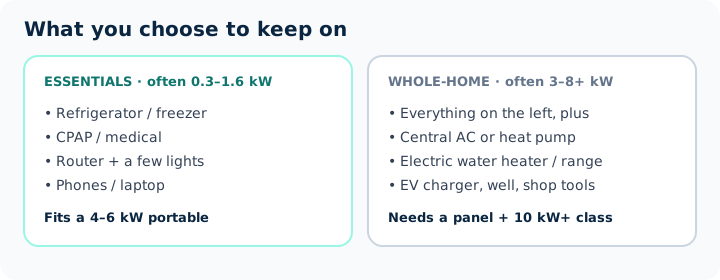
Fridge 100–200 W, keep the door shut. Internet 20–40 W. CPAP 30–90 W; an oxygen concentrator’s loads differ. Well or sump 800–1,200 W running. A ~4 kWh portable covers fridge + internet + CPAP through the first night if you shed everything else. It is not a house.
Hour 6–24
The fridge is the load that earns its keep. ~4 kWh usable is about 3.5 kWh after inverter loss — roughly 20 hours of fridge + net if you do not add a well or a window AC. Municipal water often lasts a day; a well without a started pump does not. Do not add the range, dryer, or EV charger.
Day 2–3
Night two is an extra battery, not a second brand. Anker BP3800 $1,799.99 Halloween sale / $1,999.99 list (checked 26 Oct 2026, sale ends 1 Nov 2026). EcoFlow Ultra extra $2,399 alone or $2,299 as an Ultra X add-on (27 Sep 2026). DELTA Pro 3 extra $1,899. EcoFlow 400 W panel $699 (EcoFlow US, 25 Oct 2026). Landfall is not solar weather. ~12 kWh is days on fridge + net, hours on a running well. Not multi-day central air.
Day 4+
~20 kWh stretches fridge + net into several days. HVAC is Ultra X + SHP3 or a Powerwall quote. Charge every pack from the wall before a forecast outage. Use the charge list.
What fails first
| Load | When it fails | Running watts | Plan |
|---|---|---|---|
| Internet + phones | Minutes if the ONT has no battery | 20–40 W | Keep |
| Refrigerator | Hours if you open the door | 100–200 W avg | Keep |
| CPAP / medical | First night | 30–90 W | Keep if anyone uses one |
| Well / sump | First toilet or basement inch | 800–1,200 W running | Keep only if the inverter can start it |
| Furnace fan / controls | First cold night | 200–400 W fan | Keep controls. Shed big heat. |
| Lights | Dusk | 10 W per LED | One circuit |
| Central AC / heat pump | First hot or cold afternoon | Thousands of W | Shed on a portable |
| Range, dryer, EV, water heater | Whenever you turn them on | 3–11 kW | Shed |
What this size actually runs
| Size | Fridge + internet | Well (running) | Partial house | Whole-home HVAC |
|---|---|---|---|---|
| ~4 kWh (F3800 Plus / DELTA Pro 3) | ~17 hours | ~3.5 hours (start is 6–9 kW) | ~2 hours | No. Shed HVAC. |
| ~12 kWh (Ultra X starter) | ~2 days | ~10 hours running if it can start | ~6–7 hours | Short automatic backup only. Not multi-day HVAC. |
| ~20 kWh (4× B500 or Ultra extras) | ~3–4 days | ~16 hours running | ~11 hours | Still not a silent whole-home week. Plan to shed. |
Run the same formula with your watts on the runtime calculator.
Cold 2-day ice / Nor’easter planning (circuits before kits): ice-storm 2-day home battery backup.
FAQ
Start with the load you will not give up. Fridge and CPAP do not need 12 kW. A well might.
View F3800 Plus on Anker View Ultra X on EcoFlow Open the calculator Ice / 2-day